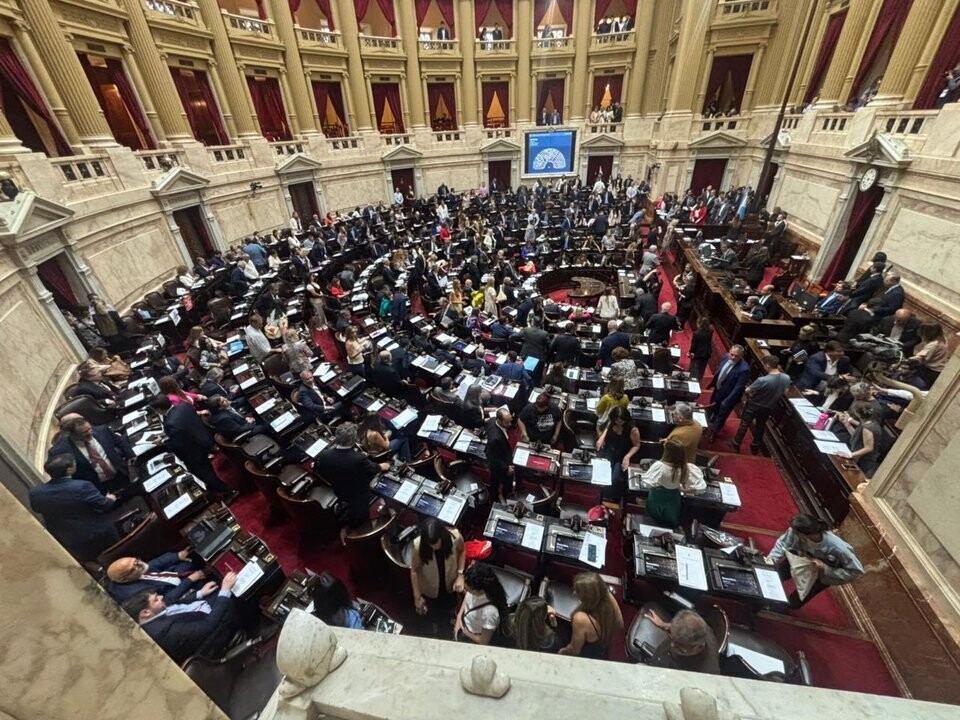
This week, the National Congress will reactivate with two sessions to be held between Wednesday and Thursday in the Chamber of Deputies and the Senate to vote on the Glacier Reform Law and approve the appointments of around 60 judges and prosecutors. Parliament has returned to a faster pace after extraordinary sessions in December and February where the Budget, Fiscal Innocence, Juvenile Penal Regime, the Mercosur-European Union agreement, and the controversial labor reform—currently being debated in court hallways—were approved, according to sources to the Argentine News Agency. In March, following President Javier Milei's speech at the opening of the ordinary sessions, activity in the Chamber of Deputies decreased significantly, with the main activities being the formation of commissions and the public hearing on the Glacier Law. The Senate is focused on processing the 60 files sent by the Government for the 300 vacancies in the Judicial Branch, after nearly two years of paralysis in this matter. However, the sessions will be overshadowed by controversies surrounding the increase in the assets of the Head of Cabinet, Manuel Adorni, and new revelations in the Libra case, which involves Milei and his sister, Karina Milei. The public hearing on the Glacier Law. Chamber of Deputies On Tuesday, the Chamber of Deputies will hold an informational meeting of the plenary of the Natural Resources and Constitutional Affairs commissions, chaired by libertarians José Peluc and Nicolás Mayoraz, where governors or their ministers from the Mesa del Cobre will present. The meeting will not be without controversy, as the opposition will again demand a new public hearing, as only 400 of the 100,000 registered were able to speak at the one held on March 25 and 26. Nevertheless, the ruling party and its allies will seek to conclude the round of consultations on the same Tuesday and issue the opinion that will allow for debate in the session room on Wednesday. The passing of this law is a demand from the governors of the Mesa del Cobre to attract million-dollar mining investments. This week will also see the completion of the formation of the Mercosur commission, which will now be led by Unión por la Patria, as well as the commissions for Internal Security, Social Security, and Human Rights and Guarantees. Peronism will once again appoint the porteño Eduardo Valdés to head the Mercosur commission, a position he held from July 1, 2025, to December 9. Patricia Bullrich agreed with opposition blocs to hold sessions this week. Senate The Senate will hold sessions this week to expedite the approval of around 60 files for judges, prosecutors, and defenders, in a clear signal to the judiciary. The Government wants to maintain a good relationship with the justice system and therefore seeks to fill at least 60 of the 300 vacancies in the Judicial Branch, but to do so, it must complete a legislative process that will take at least a month. Among the files submitted to the upper house is the nomination of Emilio Rosatti, son of the President of the Supreme Court, Horacio Rosatti, for a position in a federal trial court in the city of Santa Fe. The file of María Julia Sosa, secretary to the court of Julián Ercolini—the magistrate who handled high-profile cases involving former President Cristina Kirchner, such as Vialidad and Hotesur-Los Sauces—was also included.